Monday, November 23, 2009

Pattern making(for begginners)

Making a paper pattern is a must for the beginners. I prefer to make paper patterns and then cut the fabric. It saves time and material and the paper draft is reusable. We can adjust the placing of the paper pattern on the fabric according to the material available. If the fitting is not good we can make necessary alterations in the paper pattern itself. Same paper pattern can be used as basic and design different patterns
Materials needed
1. Sheet of paper.
We need thick sheet of paper if we want keep the draft for a long time and use it again and again. If not news paper is well and good. Once we get correct fitting we can make cut pattern in thick cardboard and use it for future use.
2. Pencil
3. Eraser
4. Ruler
In the paper pattern ½” seam allowance will be there unless it is mentioned.name of the parts should be written .If two identical parts are cut separately we have to mark R and L on the draft. For example sleeves. Especially while cutting plain material we end up cutting two right sleeves.
½” seam should be added to attach button stands. If we have ample material button can be cut along with the bodice. Care must be taken to mark the place by notches from where the button strand starts. Notches should be made to mark important points that must coincide while stitching. The point of notch should project beyond the cutting line of the pattern.


Photobucket

Friday, November 20, 2009

Puff sleeves with gathers at the top only


Swing the sections apart at the cap line only keeping the sleeve edge together.Give shape as shown in the figure . We get gathers, only at the cap of the sleeve.

 Another method

Puff sleeves with gathers at bottom only


By spreading the sections only at the bottom as shown in the figure sleeves will have gathers only at the bottom .

puff sleeves with more fullness


Plenty of fullness at top and bottom of the sleeve can be obtained by making more sections and spreading them apart Mid line of the sleeve is extended both ways
as shown in the figure 2. Shape is given as shown.

Thursday, November 19, 2009

Varieties of puff sleeves from plain sleeve


Here are a few varieties of puff sleeves.

Wednesday, November 18, 2009

Puffed sleeves


Puffed sleeve has gathers at the armhole as well as at the sleeve round. There are several types of puffed sleeves. At the edge of the sleeve some will have sleeve band, some will have piping and some will have open gathers .Some will have more fullness at the top as well as at the bottom. Some will be tight the bottom and very loose at the top. Mutton leg sleeve will have more fullness at the top and will be tight fitting at the bottom. On the whole the shape of the puff sleeves depends upon the gathers.

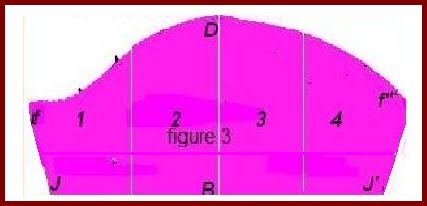
Draw the outline of the basic plain sleeve on a brown paper and divide it in to 4 equal parts (fig 3) label them as 1, 2, 3 and 4 On another sheet of paper draw a line and arrange the four portions in the same order in the same order leaving gaps between each portion such that the new distance between J and J’ is 1½ times the original J-J’ measurement. Spaces between the four portions should be equal. Secure the portions to the sheet with pins.
Mark D’ ¾” above D and B’ ¾ below B and draw connecting lines between the four portions as shown by dotted line in the figure 5.cut along the line J’-B-J F- D-’F’and J’.T his is the draft of the puffed sleeve

Method of drafting plain sleeve


Measurements needed
Sleeve length
Sleeve round
Chest
Mark B-D on fold = Sleeve length +½” (Shaded portion is 1” for in turn for plain sleeve.)
D-C =1/12 Th chest+½”
Draw perpendiculars from D, C, and B
D-E =¼ chest -1”
D-E =C-F
B-J= half sleeve round + ½”
Join D-F and F-J
Divide D-F into four equal parts by points G,H and I. Draw perpendiculars from those points such that
G-K= ¼”, H-L=½” and I-M=¼”
Join the points F-K-H-M-D by a curved line as shown in the figure. This is the front portion of the sleeve.
Join the points F-L-D -by a curved line as shown in the figure. This is the back portion of the sleeve.
Cut the paper draft along the line B-J-F-L-M-D. Open the fold .and cut along the curved line F-K-H-M-D.
This is the draft of basic plain sleeve. Outline of the draft is traced on a fairly thick card board and a block is prepared which can be used as foundation for all other types of sleeves.